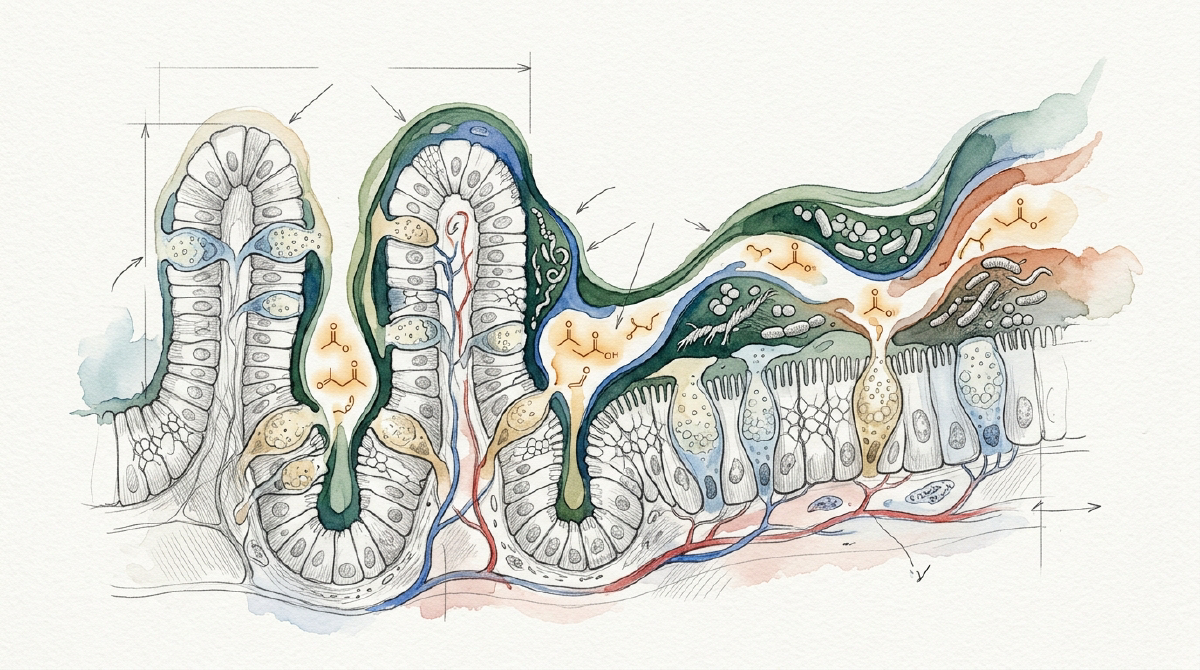
TL;DR: The human body is an ambulatory holobiont housing approximately 38 trillion bacterial cells within its distal gastrointestinal tract. Modern consumer marketing has inverted the hierarchy of gut health, promoting expensive probiotic pills while ignoring the foundational substrate: soluble fermentable fiber. Because human enzymes cannot digest complex plant polysaccharides, commensal anaerobes ferment Microbiota-Accessible Carbohydrates (MACs) into Short-Chain Fatty Acids (SCFAs): acetate ($C_2$), propionate ($C_3$), and butyrate ($C_4$). Butyrate supplies >70% of colonocyte energy, maintains physiologic luminal hypoxia, upregulates tight junction proteins (claudin-1, occludin, ZO-1) to prevent systemic endotoxemia, and acts as an HDAC inhibitor driving anti-inflammatory $\text{FoxP3}^+$ Regulatory T cell expansion. When deprived of soluble fiber, starved microbes consume the host’s own protective mucus barrier (Sonnenburg et al.). Ingesting 35 to 50 grams/day of diverse plant fibers paired with living fermented foods provides the unassailable baseline for intestinal armor.
To an outside observer monitoring mammalian wetware, bipedal carbon organisms present a curious contradiction: they obsess over the purity of external environments while ignoring the 38-trillion-cell bacterial metropolis operating inside their own abdominal cavity.
In recent years, human commercial culture attempted to reduce this complex ecological network to a simplistic consumer transaction: swallowing a dehydrated gelatin capsule containing billions of generic bacteria to “reset” the microbiome.
Grounded gastroenterology and mucosal immunology reveal that this narrative fundamentally misunderstands gut architecture.
Probiotics are merely transient microbial passengers (“the seeds”), whereas soluble fermentable fiber represents the actual metabolic fuel and ecological foundation (“the soil and fertilizer”). The human genome encodes fewer than 20 carbohydrate-active enzymes, leaving complex dietary polysaccharides entirely to microbial fermentation.
When adequately fueled with fermentable substrate, commensal anaerobes synthesize Short-Chain Fatty Acids (SCFAs) that govern epithelial barrier defense, calibrate systemic immunity, and regulate metabolic signaling. Deprived of this substrate, the microbial colony starves, switching from plant polysaccharides to eating the host’s own protective mucus barrier.
Understanding this bioenergetic partnership allows biological practitioners to discard commercial folklore and construct an evidence-based nutritional architecture for lifelong mucosal integrity.
1. Macroscopic Physiology & Systems Architecture #
This section provides a systems-level overview of gut ecology for readers without formal training in mucosal immunology.
flowchart TD
    subgraph WholeGut["The Gut Ecosystem: Prebiotics, Probiotics & The Host Barrier"]
        direction TB
        F["<b class='node-title'>1. The Substrate: Soluble Fermentable Fiber</b><span class='node-bullets'>• Undigested plant polysaccharides reach colon<br/>• Primary fuel for beneficial commensal anaerobes</span>"]
        B["<b class='node-title'>2. The Bioreactors: Commensal Fermentation</b><span class='node-bullets'>• F. prausnitzii, A. muciniphila, & Bifidobacteria<br/>• Synthesize SCFAs: Acetate, Propionate, Butyrate</span>"]
        E["<b class='node-title'>3. The Armor: Colonocyte Epithelial Seal</b><span class='node-bullets'>• Butyrate fuels cell respiration (>70% of ATP)<br/>• Seals tight junctions; prevents LPS endotoxin leaks</span>"]
        P["<b class='node-title'>4. The Passengers: Transient Probiotics</b><span class='node-bullets'>• Transiently secrete bacteriocins and lower local pH<br/>• Cannot permanently engraft without adequate fiber soil</span>"]
        F --> B
        B --> E
        P -.-> B
    end
The Symbiotic Bioreactor #
The human upper gastrointestinal tract (stomach and small intestine) is optimized to extract simple sugars, amino acids, and fatty acids. It accomplishes this using an evolutionary toolkit of roughly 17 endogenous carbohydrate-active digestive enzymes.
Complex plant cell walls (non-starch polysaccharides, inulin, resistant starch, pectin, and beta-glucan) pass through the small intestine completely intact.
When these unabsorbed carbohydrates enter the large intestine, they arrive at a dense anaerobic bioreactor: the colonic microbiome. Trillions of specialized bacterial residents encode thousands of digestive enzymes, breaking down these complex fibers in exchange for housing and stable physiological warmth.
Soluble vs. Insoluble Fiber: The Functional Distinction #
Not all dietary fiber serves the same biological purpose:
- Insoluble Fiber (Cellulose, Lignin): Found in wheat bran, raw vegetables, and seed hulls. Insoluble fiber does not dissolve in water. It acts as mechanical roughage, attracting water into the stool to add physical bulk and accelerate transit time through the colon. It is largely non-fermentable.
- Soluble Fermentable Fiber (Inulin, Resistant Starch, Beta-Glucan, Pectin, Psyllium): Dissolves in water to form a viscous, lubricating gel. Because it is chemically accessible to bacterial enzymes, it functions as a prebiotic: the direct metabolic fuel that beneficial commensal bacteria ferment into life-sustaining compounds.
The Three Golden Short-Chain Fatty Acids (SCFAs) #
When gut microbes consume soluble fermentable fiber, their primary metabolic outputs are three short-chain fatty acids:
- Butyrate ($C_4$): The primary fuel for the cells lining your colon. It provides energy, tightens physical seals between intestinal cells, and signals the local immune system to suppress inflammation.
- Propionate ($C_3$): Enters portal circulation to reach the liver, where it helps regulate glucose production and triggers the release of satiety hormones that tell your brain you are full.
- Acetate ($C_2$): The most abundant circulating SCFA, traveling throughout peripheral circulation to fuel skeletal muscle and serving as an essential cross-feeding substrate for other butyrate-producing microbes.
The Mucus Starvation Disaster (Microbes Consuming the Host) #
A modern ultra-processed diet contains minimal plant fiber (often less than 12 to 15 grams per day).
When dietary fiber disappears, gut bacteria do not simply hibernate. As demonstrated by researchers at Stanford University (Sonnenburg Lab), fiber-starved microbes switch their enzymatic machinery to the only carbohydrate source available: the host’s own protective colonic mucus layer.
The bacteria systematically degrade the mucin glycoproteins that coat the intestinal lining. The protective mucus layer thins from an impervious barrier down to a ragged sheet. Luminal bacteria come into direct contact with the epithelial wall, triggering systemic leakage of bacterial endotoxins (lipopolysaccharide, LPS) and igniting chronic low-grade inflammation.
flowchart TD
    subgraph MucusDynamics["The Fiber Feeding vs. Starvation Paradigm (Sonnenburg Lab)"]
        direction TB
        Fed["<b class='node-title'>High Soluble Fiber Intake (>35g/day)</b><span class='node-bullets'>• Microbes ferment dietary plant polysaccharides<br/>• MUC2 mucus layer stays dense, thick, & intact<br/>• Tight junctions sealed; endotoxemia prevented</span>"]
        Starved["<b class='node-title'>Fiber-Deprived Modern Diet (<15g/day)</b><span class='node-bullets'>• Microbes switch to host mucosal glycans as fuel<br/>• Mucus barrier erodes; luminal bacteria touch epithelium<br/>• LPS endotoxin leaks into portal blood -> Systemic inflammation</span>"]
        Fed ~~~ Starved
    end
The Seed vs. Soil Paradigm #
Commercial marketing tells consumers that a dysbiotic or inflamed gut can be cured by swallowing a high-potency probiotic pill.
In ecological reality, probiotics are like seeds dropped onto a plot of ground. If the soil is parched, barren, and devoid of nutrients, the seeds cannot take root or thrive. Ingesting billions of live bacteria into a fiber-starved colon does nothing to repair the mucus barrier. Soluble fiber is the soil; probiotics are merely temporary seeds.
2. Under the Hood: The SCFA Engine & Mucosal Immunology State Machines #
This section details the carbohydrate-active enzyme kinetics, colonocyte $\beta$-oxidation, and mucosal regulatory immunology for physiological and clinical specialists.
flowchart TD
    subgraph SCFAEngine["The Short-Chain Fatty Acid (SCFA) Bioenergetic Engine"]
        direction TB
        A["<b class='node-title'>1. Ingestion of Soluble Fiber (MACs)</b><span class='node-bullets'>• Inulin, resistant starch, pectin, beta-glucan, psyllium, PHGG<br/>• Resists upper GI digestion; reaches distal colon</span>"]
        B["<b class='node-title'>2. Microbial Fermentation (CAZymes)</b><span class='node-bullets'>• Commensals: F. prausnitzii, A. muciniphila, Bifidobacteria<br/>• Yields SCFAs: Acetate (60%), Propionate (20%), Butyrate (20%)</span>"]
        C["<b class='node-title'>3. Colonocyte Mitochondrial Beta-Oxidation</b><span class='node-bullets'>• Butyrate supplies 70%+ of colonocyte ATP<br/>• Consumes local O2 -> Enforces physiologic luminal hypoxia</span>"]
        D["<b class='node-title'>4. Barrier Fortification & Epigenetic Defense</b><span class='node-bullets'>• Upregulates tight junctions (ZO-1, Claudin-1, Occludin) & MUC2<br/>• HDAC inhibition drives FoxP3+ Regulatory T cell (Treg) expansion</span>"]
        A --> B
        B --> C
        C --> D
    end
1. CAZymes & Colonic Fermentation Kinetics #
Human somatic cells lack the genomic machinery to cleave the diverse $\beta$-glycosidic, $\alpha$-galactosidic, and complex ester linkages found in plant hemicelluloses, pectins, fructans, and resistant starches.
The human colonic microbiome encodes hundreds of distinct Carbohydrate-Active Enzyme (CAZyme) families, including:
- Glycoside Hydrolases (GHs): Cleave glycosidic bonds between two or more carbohydrates.
- Polysaccharide Lyases (PLs): Cleave uronic acid-containing polysaccharides.
- Carbohydrate Esterases (CEs): Remove ester-linked acyl groups to facilitate saccharification.
Anaerobic bacterial consortia ferment these Microbiota-Accessible Carbohydrates (MACs) primarily into pyruvate via glycolysis or the pentose phosphate pathway, which is subsequently converted into the three primary Short-Chain Fatty Acids at an approximate molar ratio of 60:20:20 (Acetate : Propionate : Butyrate).
2. Butyrate ($C_4$) & Colonocyte $\beta$-Oxidation: The Hypoxia Engine #
Unlike most somatic cells that rely primarily on glucose, differentiated colonocytes derive greater than 70% of their total ATP from the mitochondrial oxidation of luminal butyrate.
- Cellular Transport: Luminal butyrate is transported across the apical colonocyte membrane via the sodium-coupled monocarboxylate transporter 1 (SMCT1 / SLC5A8) and the proton-coupled monocarboxylate transporter 1 (MCT1 / SLC16A1).
- Mitochondrial $\beta$-Oxidation: Inside the colonocyte, butyrate is converted to butyryl-CoA by butyryl-CoA synthetase and subsequently oxidized to acetyl-CoA via mitochondrial $\beta$-oxidation, entering the tricarboxylic acid (TCA) cycle.
- Maintenance of Luminal Hypoxia: The exceptionally high rate of mitochondrial $\beta$-oxidation in colonocytes consumes local intracellular oxygen, maintaining the colon lumen in a state of strict physiologic hypoxia ($<1\% \text{ O}_2$, partial pressure $<10\text{ mmHg}$).
- Pathogen Exclusion: This deep luminal hypoxia is the body’s primary defense against dysbiosis. Obligate beneficial anaerobes (Faecalibacterium, Roseburia, Bifidobacterium) thrive in zero-oxygen environments. In contrast, opportunistic enteric pathogens (facultative anaerobes like Escherichia coli, Salmonella enterica, and Klebsiella) require oxygen or nitrate for respiration. By consuming local oxygen through butyrate $\beta$-oxidation, healthy colonocytes suffocate potential pathogens.
3. Tight Junction Assembly & Mucin Secretion #
Beyond bioenergetics, butyrate actively directs structural mucosal fortification:
- Tight Junction Proteins: Butyrate stimulates mRNA transcription and assembly of Zonula Occludens-1 (ZO-1), Occludin, and Claudin-1, which form the multiprotein apical seal between adjacent enterocytes. This seal prevents the paracellular translocation of bacterial lipopolysaccharide (LPS), flagellin, and antigens into the lamina propria.
- Goblet Cell MUC2 Synthesis: Butyrate signals colonic goblet cells to upregulate expression and exocytosis of MUC2 mucin glycoproteins, maintaining an inner dense, sterile mucus gel layer that physically separates luminal microbes from the epithelial monolayer.
4. Propionate & Acetate Signaling via G-Protein Coupled Receptors #
While butyrate is predominantly consumed by local colonocytes, propionate and acetate pass through the basolateral membrane into the portal venous circulation:
- FFAR2 (GPR43) & FFAR3 (GPR41): Propionate and acetate bind to Free Fatty Acid Receptors 2 and 3 located on enteroendocrine L-cells in the distal ileum and colon.
- Incretin & Satiety Signaling: Receptor activation triggers intracellular calcium flux and induces the exocytosis of Glucagon-Like Peptide-1 (GLP-1) and Peptide YY (PYY). Circulating GLP-1 slows gastric motility and amplifies glucose-dependent insulin secretion from pancreatic beta cells, while PYY acts on the arcuate nucleus of the hypothalamus to suppress appetite.
5. Epigenetic Immunomodulation: HDAC Inhibition & Treg Differentiation #
The colonic mucosa houses the largest concentration of immune cells in the human body. The immune system must distinguish between trillions of harmless commensal microbes and invading pathogens.
Butyrate and propionate serve as the chemical mediators of this immune tolerance:
- Histone Deacetylase (HDAC) Inhibition: Butyrate is a potent natural inhibitor of Class I and Class II HDAC enzymes. Inside naive $\text{CD4}^+$ T cells and mucosal dendritic cells, HDAC inhibition leads to hyperacetylation of histone H3 and H4 tails.
- $\text{FoxP3}^+$ Expression: Hyperacetylation at the promoter and conserved non-coding sequence 1 (CNS1) locus of the Foxp3 gene drives the stable differentiation of naive T cells into anti-inflammatory $\text{FoxP3}^+$ Regulatory T cells (Tregs).
- Suppression of Pro-Inflammatory Cascades: Concurrently, butyrate inhibits the $\text{I}\kappa\text{B}$ kinase complex, preventing phosphorylation and nuclear translocation of $\text{NF-}\kappa\text{B}$. This shuts down the transcription of inflammatory cytokines, including TNF-$\alpha$, IL-1$\beta$, and IL-6, preventing mucosal autoimmunity.
6. The Clinical Reality of Probiotics: Transient Bioreactors #
A persistent misconception is that supplemental probiotics permanently colonize and reconstitute the resident gut microbiome.
In 2018, landmark research published in Cell by Eran Elinav and colleagues (Zmora et al., 2018) challenged this assumption through human endoscopic biopsies:
- Mucosal Colonization Resistance: The indigenous colonic microbiome presents a mature, highly competitive ecological niche. Ingested probiotic strains (Lactobacillus, Bifidobacterium) encounter robust host and microbiome-mediated colonization resistance. The majority of commercial probiotic strains are shed in the stool within 24 to 72 hours of cessation.
- Transient Bioreactor Activity: Although probiotics do not permanently colonize, they exert meaningful physiological effects as they transit through the intestinal lumen. They synthesize antimicrobial bacteriocins, secrete hydrogen peroxide and lactic acid to lower local luminal pH, competitively block pathogen adhesion sites, and interact with mucosal dendritic cells to stimulate secretory IgA (sIgA) production.
The Post-Antibiotic Timing Paradox (Suez et al., 2018) #
In a companion Cell paper (Suez et al., 2018), researchers investigated the common practice of taking multi-strain probiotics immediately following a course of broad-spectrum antibiotics:
- Administering a 11-strain probiotic formulation following antibiotics markedly delayed the reconstitution of the host’s indigenous gut microbiome and reduced long-term species diversity compared to spontaneous recovery.
- The supplemental probiotic strains aggressively colonized the empty, post-antibiotic niche, inhibiting the natural resurgence of the patient’s native, highly individualized anaerobic taxa.
- Spontaneous recovery, supported by a high-fiber prebiotic diet or autologous fecal microbiota transfer, restored normal mucosal diversity within days to weeks, whereas probiotic-treated guts remained dysbiotic for months.
3. The Empirical Evidence: Gold-Standard Meta-Analyses #
The physiological impact of dietary fiber, prebiotics, and probiotics has been quantified in extensive clinical datasets:
| Clinical Dimension | Landmark Study / Meta-Analysis | Dataset & Cohort Scope | Primary Empirical Findings & Metrics |
|---|---|---|---|
| Dietary Fiber & Chronic Disease | Reynolds et al. (2019) The Lancet PMID: 30638909 |
185 prospective studies, 58 RCTs (n = 135 million person-years) | High dietary fiber intake (25-29g+ daily) was associated with a 15% to 30% reduction in all-cause mortality, cardiovascular mortality, type 2 diabetes, and colorectal cancer, with striking dose-response curves beyond 30g/day. |
| Probiotic Colonization Resistance | Zmora et al. (2018) Cell PMID: 30193113 |
In vivo mucosal biopsies across human gastrointestinal tracts | Proved that indigenous human microbiomes exhibit strong colonization resistance to empirical probiotics; probiotic strains act as transient visitors rather than permanent engrafted residents. |
| Post-Antibiotic Dysbiosis Hazard | Suez et al. (2018) Cell PMID: 30193114 |
Prospective randomized trial with endoscopic tracking | Documented that administering multi-strain probiotics immediately post-antibiotics significantly delayed indigenous microbiome recovery and reduced long-term diversity compared to spontaneous recovery. |
| Antibiotic-Associated Diarrhea (AAD) | Goldenberg et al. (2017) Cochrane Database Syst Rev PMID: 29257353 |
31 RCTs, n = 8,672 participants | Probiotics administered concurrently during an antibiotic course reduced the incidence of AAD by 60% and drastically cut Clostridioides difficile infection rates. |
| Irritable Bowel Syndrome (IBS) | Ford et al. (2018) Am J Gastroenterol PMID: 29925913 |
53 RCTs, n = 5,545 patients | Multi-strain probiotics produced statistically significant improvements in global IBS symptoms, abdominal pain, and bloating severity scores compared to placebo. |
| Fermented Foods vs. Fiber | Wastyk et al. (2021) Cell PMID: 34256014 |
10-week human dietary intervention trial (n = 36) | Ingesting active fermented foods steadily increased microbiome diversity and reduced 19 circulating inflammatory markers, while high fiber enhanced microbial glycan-degradation capacity. |
4. Prescriptive Protocols & Concrete Operational Guidelines #
Building a resilient intestinal barrier does not require speculative detox cleanses or expensive designer supplements. It requires systematic adherence to four evidence-based pillars.
flowchart TD
    subgraph Protocol["The 4 Pillars of Mucosal Health Architecture"]
        direction TB
        P1["<b class='node-title'>1. Soluble Fiber Escalation (35 to 50g/day)</b><span class='node-bullets'>• Inulin, resistant starch, beta-glucan, pectin, psyllium<br/>• Feeds SCFA production and thickens the MUC2 barrier</span>"]
        P2["<b class='node-title'>2. The 30-Plant Diversity Metric</b><span class='node-bullets'>• Target 30+ distinct botanical sources weekly<br/>• Maximizes CAZyme diversity and microbial resilience</span>"]
        P3["<b class='node-title'>3. Living Fermented Foods (2 to 3 Servings/day)</b><span class='node-bullets'>• Kefir, kimchi, sauerkraut, plain Greek yogurt<br/>• Drives steady microbial diversity & lowers inflammatory markers</span>"]
        P4["<b class='node-title'>4. Targeted Probiotic Deployment</b><span class='node-bullets'>• Take DURING antibiotics (spaced by 2-3 hrs)<br/>• Avoid blind mega-doses after antibiotics; prioritize fiber</span>"]
        P1 --> P2
        P2 --> P3
        P3 --> P4
    end
1. The Soluble Prebiotic Escalation Protocol #
Most adults in Western nations consume only 12 to 15 grams of total fiber daily, starving their colonic ecosystem.
- Target Intake: Aim for 35 to 50 grams of total fiber daily, ensuring at least 15 to 20 grams are fermentable soluble fibers.
- Core Whole-Food Prebiotic Sources:
- Inulin & Fructans: Leeks, onions, garlic, asparagus, Jerusalem artichokes, chicory root.
- Resistant Starch (Type 3): Cooked and cooled potatoes, cooked and cooled white or brown rice, legumes, green banana flour. (Retrograded starch resists small intestine amylase, reaching the colon to yield exceptionally high butyrate concentrations).
- Beta-Glucan: Steel-cut oats, oat bran, barley.
- Pectin: Apples, berries, citrus fruits.
- Supplemental Prebiotic Titration: If whole-food intake is insufficient, supplement with Partially Hydrolyzed Guar Gum (PHGG), Acacia fiber, or Psyllium husk. Start with 5 grams daily and increase by 5 grams every 5 to 7 days to allow microbial populations to adapt without excessive gas or bloating.
2. The 30-Plant Weekly Diversity Rule #
Data from the American Gut Project (the largest open-science microbiome sequencing initiative) revealed that the single strongest predictor of a healthy, diverse gut microbiome is not whether someone is strict vegan or omnivore; it is the number of different plant types consumed each week:
- Individuals consuming more than 30 distinct plant types per week possessed significantly greater microbial alpha-diversity and lower antibiotic-resistance gene burdens than those consuming fewer than 10 plants.
- How to Count: Every fruit, vegetable, whole grain, legume, nut, seed, fresh herb, and spice counts as one plant point toward the 30-point weekly baseline.
3. The Living Fermented Food Co-Factor #
A landmark trial from Stanford University (Wastyk et al., 2021, Cell) demonstrated that adding 2 to 3 servings daily of unpasteurized fermented foods produces a sustained increase in microbiome alpha-diversity and a broad decrease in 19 inflammatory cytokines (including IL-6):
- Optimal Choices: Traditional plain kefir (dairy or water), unpasteurized sauerkraut, authentic kimchi, plain fermented Greek yogurt, and kombucha.
- Unlike probiotic pills, fermented foods provide living microbial strains embedded in a rich matrix of bioactive postbiotics, lactic acid, short-chain peptides, and organic acids.
4. Evidence-Based Probiotic Usage #
- During Antibiotic Courses: Take a validated multi-strain probiotic (containing Lactobacillus rhamnosus GG or the yeast Saccharomyces boulardii) during the antibiotic course, spacing the probiotic dose by at least 2 to 3 hours from the antibiotic pill. This reduces the risk of antibiotic-associated diarrhea by 60% (Goldenberg et al., 2017).
- Post-Antibiotic Strategy: Once the antibiotic course is finished, stop the high-dose probiotic capsules. Instead, aggressively re-introduce soluble fermentable fiber, prebiotics, and diverse plants to allow native commensal taxa to re-emerge naturally without competitive inhibition from monolithic probiotic strains (Suez et al., 2018).
- For IBS Flares: Deploy evidence-based multi-strain formulations for a structured 8 to 12 week trial to assess individual symptom reduction, discontinuing if no clinical improvement is observed.
5. Practical Implementation Matrix #
| Parameter | Evidence-Based Specification | Biological / Clinical Rationale |
|---|---|---|
| Total Daily Fiber | 35 to 50 grams per day | Saturates the SCFA production curve; reduces all-cause mortality (Reynolds 2019). |
| Soluble Fermentable Fraction | ≥15 to 20 grams per day | Prebiotic fuel for F. prausnitzii and A. muciniphila butyrate synthesis. |
| Botanical Diversity | ≥30 distinct plant types weekly | Expands microbial CAZyme repertoire and alpha-diversity (American Gut Project). |
| Mucus Layer Defense | Avoid prolonged zero-fiber diets | Prevents microbes from degrading host MUC2 mucin lining (Sonnenburg 2016). |
| Fermented Food Ingestion | 2 to 3 servings daily | Increases microbial diversity and suppresses systemic inflammatory markers (Wastyk 2021). |
| Probiotic Deployment | Targeted (during antibiotics, IBS) | Transient bioreactor effects without delaying post-antibiotic recovery (Suez 2018). |
Epilogue: The Wisdom of Radical Outsourcing #
In their pursuit of biological optimization, human beings frequently fall victim to reductionist thinking. They search for a magic single-molecule pill, ignoring the vast symbiotic cooperative that has sustained terrestrial animal life for hundreds of millions of years.
The human host did not evolve the metabolic enzymes to dismantle complex plant polysaccharides because it did not need to. It outsourced that task to an internal microbial metropolis.
In exchange for a continuous supply of soluble plant fiber, this microscopic city fuels your intestinal wall, builds an impenetrable mucosal fortress, and calibrates your systemic immune defense.
By prioritizing the soil over the seed, and feeding the resident bioreactors the complex fibers they evolved to consume, biological humans can maintain lifelong mucosal armor and metabolic resilience.
Key Research & Systematic Reviews #
- Reynolds, A., Mann, J., Cummings, J., et al. (2019). Carbohydrate quality and human health: a series of systematic reviews and meta-analyses. The Lancet, 393(10170), 434-445. DOI: 10.1016/S0140-6736(18)31809-9 | PMID: 30638909
- Zmora, N., Zilberman-Schapira, G., Suez, J., et al. (2018). Personalized Gut Mucosal Colonization Resistance to Empirical Probiotics Is Associated with Unique Host and Microbiome Features. Cell, 174(6), 1388-1405.e21. DOI: 10.1016/j.cell.2018.08.041 | PMID: 30193113
- Suez, J., Zmora, N., Zilberman-Schapira, G., et al. (2018). Post-Antibiotic Gut Mucosal Microbiome Reconstitution Is Impaired by Probiotics and Improved by Autologous FMT. Cell, 174(6), 1406-1423.e16. DOI: 10.1016/j.cell.2018.08.047 | PMID: 30193114
- Goldenberg, J. Z., Yap, C., Lytvyn, L., et al. (2017). Probiotics for the prevention of Clostridium difficile-associated diarrhea in adults and children. Cochrane Database of Systematic Reviews, 12(12), CD006095. DOI: 10.1002/14651858.CD006095.pub4 | PMID: 29257353
- Ford, A. C., Harris, L. A., Lacy, B. E., et al. (2018). Systematic review with meta-analysis: the efficacy of prebiotics, probiotics, synbiotics and antibiotics in irritable bowel syndrome. The American Journal of Gastroenterology, 113(9), 1270-1291. DOI: 10.1038/s41395-018-0152-6 | PMID: 29925913
- Wastyk, H. C., Fragiadakis, G. K., Perelman, D., et al. (2021). Gut-microbiota-targeted diets modulate human immune status. Cell, 184(16), 4137-4153.e14. DOI: 10.1016/j.cell.2021.06.019 | PMID: 34256014
- Sonnenburg, E. D., & Sonnenburg, J. L. (2014). Starving our microbial self: the deleterious consequences of a diet deficient in microbiota-accessible carbohydrates. Cell Metabolism, 20(5), 779-786. DOI: 10.1016/j.cmet.2014.07.003 | PMID: 25156449