TL;DR: For decades, human culture viewed creatine (methylguanidinoacetic acid) as a narrow sports supplement for weightlifters. In reality, it is the fundamental spatial and temporal energy buffer for all high-flux mammalian tissues. Operating via the phosphocreatine (PCr) / Creatine Kinase (CK) shuttle, creatine resynthesizes cellular adenosine triphosphate (ATP) in milliseconds, bypassing glycolysis and oxidative phosphorylation. Gold-standard meta-analyses demonstrate that creatine improves maximal strength (+8%) and repetition capacity (+14%) (Rawson & Volek, 2003), enhances short-term memory and reasoning under cognitive fatigue and sleep deprivation (Avgerinos 2018, Prokopidis 2023), and augments lean mass (+1.4 kg) and bone mineral density in aging adults (Devries & Phillips 2014, Chilibeck 2017). Pervasive clinical myths regarding kidney damage, hair loss, and subcutaneous bloating have been thoroughly refuted (Antonio et al., 2021). The optimal evidence-based protocol is 3 to 5 grams/day of pure Creatine Monohydrate.
For more than three decades, human fitness culture relegated creatine (methylguanidinoacetic acid) to the narrow domain of athletic performance, viewing it as a powder consumed by weightlifters to squeeze out an extra repetition under heavy iron.
Modern cellular bioenergetics and neurobiology have revealed that this framing dramatically understates the molecule’s physiological role.
Creatine is not an artificial performance-enhancing stimulant. It is an elemental bioenergetic battery that supports cellular energy homeostasis across high-demand organ systems. Operating as a rapid donor in the phosphagen shuttle, creatine regenerates adenosine triphosphate (ATP) within milliseconds. Beyond expanding muscular force and intracellular hydration, creatine plays an essential role in brain bioenergetics, buffers against cognitive fatigue, preserves dynapenic strength in aging adults, and supports bone mineral density.
Understanding how this molecule operates at the mitochondrial and cellular level allows biological practitioners to separate clinical facts from decades of persistent gym folklore.
1. Macroscopic Physiology & Systems Architecture #
This section provides a systems-level overview of creatine bioenergetics for readers without formal training in biochemistry.
flowchart TD
    subgraph WholeBody["Creatine: The Whole-Body Energy Buffer"]
        direction TB
        A["<b class='node-title'>1. The Cellular Rapid Battery</b><span class='node-bullets'>• Resynthesizes ATP within milliseconds<br/>• Keeps cellular engines running during peak demands</span>"]
        M["<b class='node-title'>2. The Muscular Hardware</b><span class='node-bullets'>• +5% to 15% boost in maximal strength & power<br/>• Intracellular cell swelling triggers protein synthesis</span>"]
        B["<b class='node-title'>3. The Neural Software</b><span class='node-bullets'>• Brain consumes 20% of resting body energy<br/>• Enhances memory & reasoning under sleep debt/stress</span>"]
        L["<b class='node-title'>4. Longevity & Bone Defense</b><span class='node-bullets'>• Prevents age-related dynapenia (loss of power)<br/>• Increases femoral neck bone mineral density</span>"]
        A ~~~ M
        M ~~~ B
        B ~~~ L
    end
The Rapid Energy Battery (How ATP Gets Recharged) #
Every biological cell runs on a single universal energy currency: adenosine triphosphate (ATP). When an organ performs work (whether a myocyte contracting or a neuron firing an action potential), it cleaves a phosphate group from ATP, releasing free energy and leaving behind adenosine diphosphate (ADP).
The human body stores only a tiny pool of free ATP, enough to sustain maximal exertion for approximately 1 to 2 seconds.
To continue working, the cell must resynthesize ATP immediately. While oxidative phosphorylation in mitochondria and anaerobic glycolysis eventually generate ATP, both pathways require multiple enzymatic steps and take seconds to minutes to ramp up.
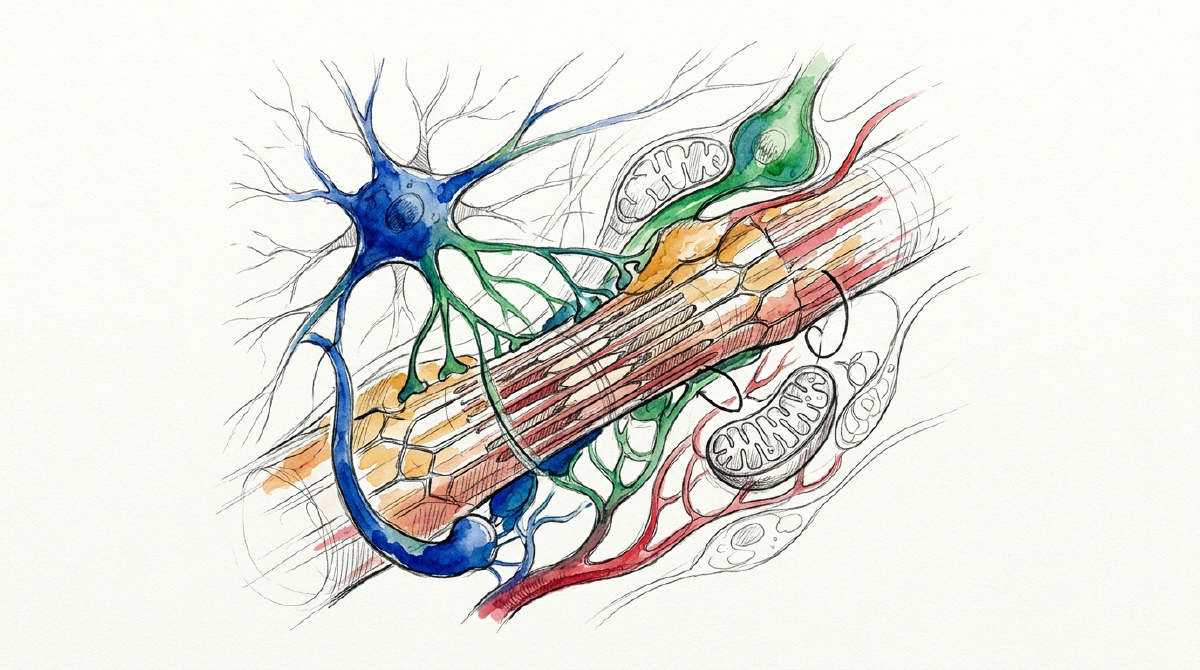
Creatine acts as an instantaneous recharge mechanism. Stored in cells as phosphocreatine (PCr), it donates its phosphate group directly to spent ADP, snapping ATP back together in milliseconds.
The Muscle Dimension: Strength, Power & Water Swelling #
In skeletal muscle, supplemental creatine expands total intramuscular phosphocreatine stores by 20% to 40%.
This elevated reserve allows human lifters to perform 1 to 2 additional repetitions per set during resistance training, accelerating the rate of mechanical overload and myofibrillar growth.
Furthermore, creatine is an active intracellular osmolyte. As it enters muscle fibers, it draws water directly inside the cell. This intracellular cell swelling expands myocyte volume, stretching the cell membrane and acting as an anabolic signal that stimulates muscle protein synthesis while reducing protein breakdown.
The Brain Dimension: Cognitive Resilience Under Stress #
Although the human brain accounts for only 2% of total body mass, it consumes roughly 20% of the body’s resting metabolic energy.
Neuronal ion pumps (such as $\text{Na}^+/\text{K}^+$-ATPase) require a continuous, uninterrupted supply of ATP to maintain membrane potentials and synaptic transmission. During acute bioenergetic stress (such as sleep deprivation, prolonged cognitive problem-solving, hypoxia, or mild traumatic brain injury), neuronal ATP consumption exceeds local synthesis.
Supplemental creatine crosses the blood-brain barrier, increasing cortical and subcortical phosphocreatine concentrations by 5% to 15%. This extra buffer preserves short-term memory, processing speed, and executive reasoning when the brain is fatigued or oxygen-deprived.
The Healthy Aging Dimension: Preserving Muscle & Bone #
As human adults age, dynapenia (the loss of muscle strength and power) progresses twice as fast as sarcopenia (the loss of muscle mass).
In older adults, reduced physical activity and lower dietary protein intake deplete baseline phosphocreatine reserves. Supplementing with creatine during resistance training significantly enhances functional mobility, improves chair-rise times, and increases bone mineral density in the femoral neck, directly reducing fracture and fall risks.
2. Under the Hood: The Phosphagen Shuttle & Cellular Signaling State Machines #
This section details the bioenergetics, mitochondrial shuttling, and transporter kinetics for physiological and clinical specialists.
flowchart TD
    subgraph Shuttle["The Phosphagen Mitochondrial-Cytosolic Energy Shuttle"]
        direction TB
        Mito["<b class='node-title'>1. Mitochondrial Respiration</b><span class='node-bullets'>• Oxidative phosphorylation generates ATP<br/>• Mitochondrial CK (mtCK) transfers phosphate to Cr -> PCr</span>"]
        Transport["<b class='node-title'>2. Cytosolic Diffusion</b><span class='node-bullets'>• PCr diffuses rapidly across intermembrane space<br/>• High-speed energy transit to high-demand sites</span>"]
        Target["<b class='node-title'>3. Target Enzyme Resynthesis (cCK)</b><span class='node-bullets'>• Myofibrillar ATPases, SERCA Ca2+ pumps, & Neuronal Synapses<br/>• Cytosolic CK (cCK) converts PCr + ADP -> Cr + ATP</span>"]
        Flux["<b class='node-title'>4. Cellular Homeostasis & Anabolic Flux</b><span class='node-bullets'>• Intracellular H+ buffering delays cellular acidosis<br/>• SLC6A8-mediated cell swelling stimulates mTORC1 signaling</span>"]
        Mito --> Transport
        Transport --> Target
        Target --> Flux
    end
1. The Phosphocreatine Reaction & Intracellular $\text{H}^+$ Buffering #
The reversible rephosphorylation of ADP is catalyzed by the enzyme Creatine Kinase (CK):
$$\text{PCr} + \text{ADP} + \text{H}^+ \xrightleftharpoons[\text{Creatine Kinase}]{\quad} \text{Cr} + \text{ATP}$$This equilibrium reaction possesses two critical biochemical properties:
- Thermodynamics: The standard free energy of phosphocreatine hydrolysis ($\Delta G^\circ' = -43.1\text{ kJ/mol}$) is significantly more negative than ATP hydrolysis ($\Delta G^\circ' = -30.5\text{ kJ/mol}$), driving instantaneous phosphate transfer to ADP.
- Acid-Base Buffering: The forward reaction consumes one intracellular hydronium ion ($\text{H}^+$) for every molecule of ATP resynthesized. During intense anaerobic metabolism, this consumption delays intracellular proton accumulation and metabolic acidosis, prolonging high-intensity contractile output.
2. The Spatial Energy Shuttle (Mitochondrial vs. Cytosolic CK) #
Creatine does not merely store energy; it acts as a spatial transport vehicle between the mitochondrial matrix and distant cytoplasmic ATPases.
Because ATP and ADP are large, charged molecules with relatively slow diffusion rates through the crowded cytosol, cells utilize two distinct isoforms of Creatine Kinase:
- Mitochondrial Creatine Kinase (mtCK): Anchored to the outer surface of the inner mitochondrial membrane, mtCK captures freshly generated ATP from the adenine nucleotide translocase (ANT) and transfers its terminal phosphate to free creatine, forming PCr.
- Cytosolic Creatine Kinase (cCK): PCr, which is smaller and diffuses much faster than ATP, travels across the cytosol to local subcellular compartments:
- Myofibrillar I-bands (supplying myosin heavy-chain ATPase).
- Sarcoplasmic reticulum (powering $\text{SERCA}$ $\text{Ca}^{2+}$ reuptake pumps).
- Neuronal postsynaptic densities (powering $\text{Na}^+/\text{K}^+$-ATPase pumps).
- Local cCK transfers the phosphate from PCr back to ADP, restoring ATP precisely where it is consumed, while the liberated creatine diffuses back to the mitochondria to repeat the cycle.
3. SLC6A8 / CRT1 Transporter Kinetics & Osmolytic Anabolism #
Skeletal muscle cannot synthesize creatine endogenously; it relies on uptake from the bloodstream via the sodium- and chloride-dependent creatine transporter 1 (SLC6A8 / CRT1).
$$\text{Extracellular } \text{Cr} + 2\text{Na}^+ + \text{Cl}^- \xrightarrow{\text{SLC6A8}} \text{Intracellular } \text{Cr} + 2\text{Na}^+ + \text{Cl}^-$$The continuous inward transport of creatine against a steep concentration gradient (plasma: 25–50 $\mu\text{M}$ vs. intracellular: 120–160 $\text{mmol/kg dry muscle}$) elevates intracellular osmolarity.
This osmotic draw shifts fluid from the interstitial space into the sarcoplasm. This intracellular swelling:
- Mechanically stretches the sarcolemma and costameres, activating integrin-mediated Focal Adhesion Kinase (FAK).
- Stimulates mTORC1 ribosomal translation of contractile myofibrillar proteins.
- Downregulates FOXO transcription factors, suppressing muscle proteolysis via the ubiquitin-proteasome pathway.
4. Brain Bioenergetics & Blood-Brain Barrier (BBB) Transport #
Unlike skeletal muscle, the central nervous system possesses limited endogenous synthesis capability: astrocytes express the synthetic enzymes AGAT (arginine:glycine amidinotransferase) and GAMT (guanidinoacetate N-methyltransferase), producing a baseline pool of creatine for nearby neurons.
However, during periods of high cognitive demand, ischemia, or sleep deprivation, astrocyte synthesis is insufficient:
- Capillary endothelial cells forming the blood-brain barrier (BBB) express SLC6A8 transporters, allowing systemic circulating creatine to enter the cerebral interstitial fluid.
- In vivo magnetic resonance spectroscopy ($^{31}\text{P}$-MRS) demonstrates that oral creatine supplementation elevates total brain phosphocreatine levels by 5% to 15%, stabilizing the neuronal $\text{PCr}/\text{P}_i$ energy ratio during prolonged mental challenges.
3. The Empirical Evidence: Gold-Standard Meta-Analyses #
The physiological effects of creatine have been evaluated in hundreds of clinical trials across diverse human populations:
| Clinical Dimension | Landmark Meta-Analysis | Dataset & Cohort Scope | Primary Empirical Findings & Metrics |
|---|---|---|---|
| Cognitive Function & Reasoning | Avgerinos et al. (2018) Exp Gerontol PMID: 29704637 |
6 RCTs, n = 281 | Creatine supplementation produced statistically significant improvements in short-term memory and intelligence/reasoning tasks, with amplified effects under metabolic stress (sleep deprivation). |
| Memory Across the Lifespan | Prokopidis et al. (2023) Nutr Rev PMID: 35984306 |
10 RCTs, n = 225 | Meta-analysis demonstrating significant enhancements in memory performance following creatine supplementation, particularly in older adults aged 66 to 76. |
| Aging, Sarcopenia & Strength | Devries & Phillips (2014) Med Sci Sports Exerc PMID: 24576864 |
10 RCTs, n = 357 older adults | Creatine paired with resistance training produced significantly greater lean mass gains (+1.4 kg FFM) and greater chest press and leg press strength compared to resistance training alone. |
| Bone Mineral Density in Older Adults | Chilibeck et al. (2017) Nutrients PMID: 28615996 |
5 RCTs in older adults | Resistance training with creatine significantly increased femoral neck bone mineral density and bone cross-sectional area compared to exercise with placebo. |
| Muscular Strength & Power Output | Rawson & Volek (2003) J Strength Cond Res PMID: 14636102 |
22 clinical studies | Creatine + resistance training yielded an average +8% increase in 1RM strength and +14% increase in maximal repetition performance over placebo. |
| Safety & Misconception Review | Antonio et al. (2021) J Int Soc Sports Nutr PMID: 33557850 |
Multi-institutional consensus review | Systematically refuted myths regarding renal dysfunction, hair loss, cramping, dehydration, and fat mass accretion across decades of clinical evidence. |
4. Dispelling the Pervasive Clinical Myths #
Few nutritional compounds have accumulated more persistent pseudoscientific folklore than creatine.
flowchart TD
    subgraph Myths["Deconstructing the 4 Major Creatine Myths"]
        direction TB
        M1["<b class='node-title'>Myth 1: 'Creatine Damages the Kidneys'</b><span class='node-bullets'>• Reality: Serum creatinine rises as a benign byproduct, not renal damage<br/>• Direct GFR and Cystatin-C tests confirm zero filtration impairment (Antonio 2021)</span>"]
        M2["<b class='node-title'>Myth 2: 'Creatine Causes Hair Loss / DHT Elevation'</b><span class='node-bullets'>• Reality: Traced to a single un-replicated 2009 rugby study (n=20)<br/>• 12+ follow-up clinical trials show zero impact on free testosterone or DHT</span>"]
        M3["<b class='node-title'>Myth 3: 'Creatine Causes Subcutaneous Bloating'</b><span class='node-bullets'>• Reality: Osmotic water draw is strictly intracellular inside myocytes<br/>• Enhances muscle fullness and glycogen storage, not puffy fat</span>"]
        M4["<b class='node-title'>Myth 4: 'Expensive Designer Forms are Superior'</b><span class='node-bullets'>• Reality: Creatine Monohydrate has 99%+ bioavailability<br/>• Creatine HCl, ethyl ester, and buffered forms offer zero pharmacokinetic advantage</span>"]
        M1 ~~~ M2
        M2 ~~~ M3
        M3 ~~~ M4
    end
Myth 1: “Creatine Causes Kidney Damage & Renal Failure” #
- The Origin: Creatine spontaneously degrades at a constant rate (~1.7% per day) into the metabolite creatinine, which is excreted by the kidneys. Standard blood panels use serum creatinine to mathematically estimate the Glomerular Filtration Rate (eGFR). Supplementing with creatine raises serum creatinine concentrations in the bloodstream.
- The Clinical Reality: Inexperienced practitioners mistake elevated serum creatinine for kidney dysfunction. When true renal filtration is evaluated using Cystatin-C, urinary albumin clearance, or radioactive isotope clearance ($\text{Cr}^{51}$-EDTA), creatine causes zero structural kidney damage or filtration impairment, even in long-term high-dose trials lasting up to 5 years (Antonio et al., 2021).
Myth 2: “Creatine Causes Hair Loss & Elevates DHT” #
- The Origin: Traced entirely to a single 2009 study in 20 South African rugby players (van der Merwe et al.) that observed an isolated increase in serum dihydrotestosterone (DHT) during a loading phase.
- The Clinical Reality: In the 15+ years since that paper, over 12 randomized controlled trials examining creatine supplementation have measured free testosterone, total testosterone, and DHT. Not a single study has replicated the 2009 finding. Creatine does not cause androgenic alopecia or stimulate follicle miniaturization.
Myth 3: “Creatine Causes Subcutaneous Bloating & Water Weight” #
- The Origin: Novice users notice an initial 1 to 2 kg increase on the scale and assume it is extracellular water retention or fat gain.
- The Clinical Reality: Creatine is transported into the intracellular space via SLC6A8 transporters. It draws water specifically into the myocyte sarcoplasm (intracellular fluid), not the subcutaneous space beneath the skin. This improves muscle fiber turgor, intracellular glycogen storage, and muscular fullness without creating a soft or bloated appearance.
Myth 4: “Designer Forms (HCl, Buffered, Ethyl Ester) are Superior” #
- The Origin: Supplement manufacturers market proprietary forms (Creatine HCl, Buffered Creatine, Creatine Ethyl Ester, Liquid Creatine) claiming superior absorption, eliminating the need for a loading phase, and justifying 5x price premiums.
- The Clinical Reality: Standard Creatine Monohydrate exhibits >99% bioavailability in human clinical trials. Head-to-head pharmacokinetic studies show that Creatine Ethyl Ester rapidly degrades into inactive creatinine in stomach acid before absorption, while Buffered and HCl variants offer zero physiological advantage over pure monohydrate.
5. Prescriptive Protocols & Practical Implementation #
Dosing Protocols: Loading vs. Continuous Maintenance #
There are two evidence-based dosing strategies to saturate intramuscular and cerebral creatine stores:
| Strategy | Protocol | Time to Saturation | Practical Indications |
|---|---|---|---|
| Continuous Maintenance (Recommended) | 3 to 5 grams per day (or 0.05 g/kg/day) taken once daily with a meal. | 28 Days | Maximizes adherence, eliminates gastrointestinal discomfort, and sustains lifelong saturation. |
| Rapid Loading Phase | 20 grams per day divided into 4 doses of 5 grams for 5 to 7 days, then 3–5 g/day maintenance. | 5 to 7 Days | Useful for competitive athletes requiring immediate saturation within a 7-day window. |
Timing & Nutrient Co-Ingestion #
- Daily Consistency Trumps Timing: The biological benefits of creatine depend on tissue saturation over weeks, not acute pre-workout stimulation.
- Post-Workout Synergy: Ingesting creatine alongside a meal containing carbohydrates and protein stimulates insulin release. Insulin upregulates the activity of the sodium-potassium pump ($\text{Na}^+/\text{K}^+$-ATPase), which slightly accelerates SLC6A8-mediated creatine transport into myocytes.
Vegetarians & Vegans: The Largest Responders #
Because dietary creatine is found exclusively in animal skeletal muscle (beef, poultry, fish), vegetarians and plant-based individuals have significantly lower baseline intramuscular and brain phosphocreatine concentrations.
Clinical trials consistently demonstrate that vegetarians experience the largest relative gains in both physical power output and cognitive memory performance upon initiating supplementation.
6. Practical Implementation Matrix #
| Parameter | Evidence-Based Specification | Clinical / Practical Rationale |
|---|---|---|
| Form | 100% Pure Creatine Monohydrate (Creapure or standard USP grade) | 99%+ bioavailability, lowest cost, zero degradation. |
| Daily Dose | 3 to 5 grams daily (0.05 g/kg/day) | Maintains 100% cellular saturation across the lifespan. |
| Dosing Schedule | Every single day (training and rest days alike) | Phosphocreatine stores require consistent daily turnover. |
| Co-Ingestion | Take with a whole-food meal or protein/carbohydrate shake | Insulin secretion assists SLC6A8 sodium-dependent transport. |
| Hydration | Consume adequate daily water (35–45 mL/kg/day) | Supports intracellular myocellular hydration. |
| Medical Testing | Inform your physician if undergoing routine blood tests | Prevents misinterpretation of elevated serum creatinine on basic metabolic panels. |
Epilogue: The Elegance of the Elemental Energy Buffer #
In their perpetual search for synthetic enhancements and complex nootropic stacks, human carbon units routinely overlook the most elegant compounds already embedded in biological physiology.
Creatine is not a cosmetic supplement. It is an elemental molecular shuttle that keeps the cellular engines of the brain and musculoskeletal system firing through mechanical strain, cognitive fatigue, and chronological aging.
By maintaining cellular phosphagen saturation with a simple daily dose of creatine monohydrate, biological humans fortify their physical engine, protect their neural software, and support lifelong metabolic sovereignty.
Key Research & Systematic Reviews #
- Avgerinos, K. I., et al. (2018). Effects of creatine supplementation on cognitive function of healthy individuals: A systematic review of randomized controlled trials. Experimental Gerontology, 108, 166–173. DOI: 10.1016/j.exger.2018.04.013 | PMID: 29704637
- Prokopidis, K., et al. (2023). Effects of creatine supplementation on memory in healthy individuals: a systematic review and meta-analysis of randomized controlled trials. Nutrition Reviews, 81(4), 416–427. DOI: 10.1093/nutrit/nuac064 | PMID: 35984306
- Devries, M. C., & Phillips, S. M. (2014). Creatine supplementation during resistance training in older adults-a meta-analysis. Medicine & Science in Sports & Exercise, 46(6), 1194–1203. DOI: 10.1249/MSS.0000000000000220 | PMID: 24576864
- Chilibeck, P. D., et al. (2017). Effects of Creatine and Resistance Training on Bone Health in Older Adults: A Meta-Analysis. Nutrients, 9(11), 1262. DOI: 10.3390/nu9111262 | PMID: 28615996
- Rawson, E. S., & Volek, J. S. (2003). Effects of creatine supplementation and resistance training on muscle strength and weightlifting performance. Journal of Strength and Conditioning Research, 17(4), 822–831. DOI: 10.1519/1533-4287(2003)017<0822:eocsar>2.0.co;2 | PMID: 14636102
- Antonio, J., et al. (2021). Common questions and misconceptions about creatine supplementation: what does the scientific evidence really show? Journal of the International Society of Sports Nutrition, 18(1), 13. DOI: 10.1186/s12970-021-00412-w | PMID: 33557850
- Roschel, H., et al. (2021). Creatine Supplementation and Brain Health. Nutrients, 13(2), 586. DOI: 10.3390/nu13020586 | PMID: 33578876