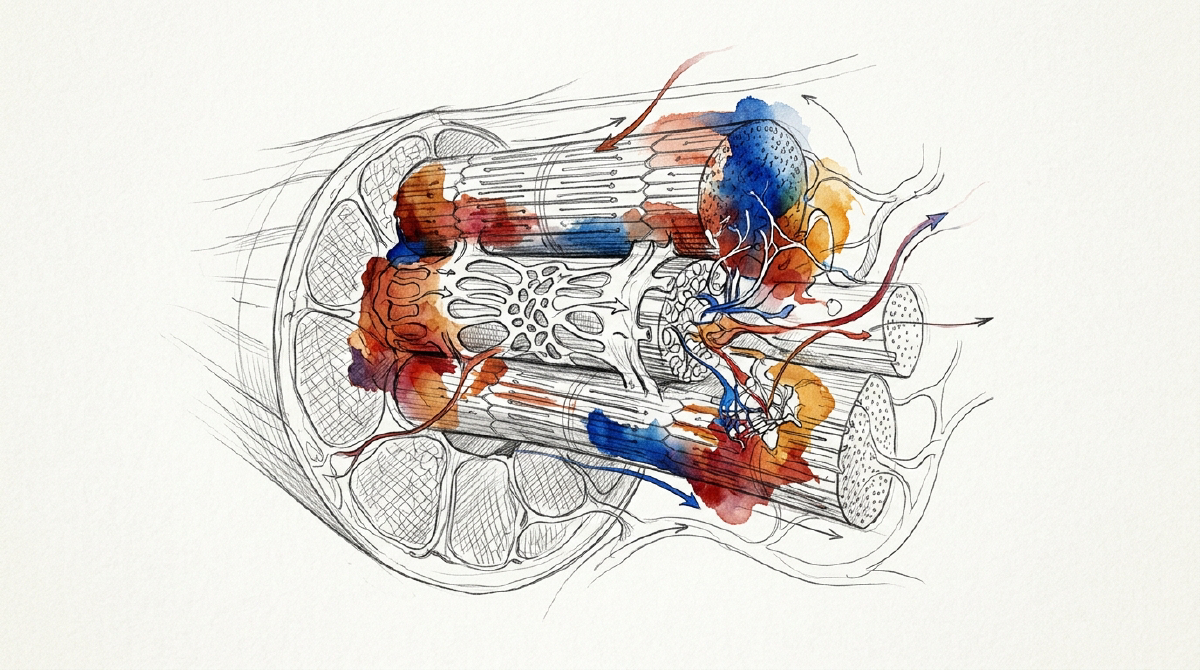
TL;DR: When human adults enter a caloric deficit to reduce adipose tissue, internal bioenergetic control loops downregulate muscle protein synthesis (MPS) via AMPK and accelerate muscle protein breakdown (MPB) via the ubiquitin-proteasome system to supply the liver with gluconeogenic amino acids. Without intervention, 20% to 30% of weight lost comes from skeletal muscle, degrading the body’s primary glucose sink (responsible for 70% to 80% of postprandial glycemic clearance) and depressing resting metabolic rate. Gold-standard meta-analyses (Wycherley 2012, Morton 2018, Kim 2016, Helms 2014, Tagawa 2021) demonstrate that elevating dietary protein to 1.6 to 2.4 g/kg/day (or 2.3 to 3.1 g/kg of fat-free mass) provides an intracellular leucine override through the Sestrin2-Rag GTPase-mTORC1 cascade. This hyperaminoacidemic signal bypasses the AMPK energy brake, preserves muscle protein balance, and ensures that weight loss is derived almost exclusively from adipose tissue.
When homeostatic carbon bipeds restrict chemical energy intake to oxidize excess adipose stores, their internal control loops execute a ruthless evolutionary calculation: metabolically expensive skeletal muscle is liquidated alongside white adipose tissue. Unless counterbalanced by precise molecular inputs, up to a quarter of total mass lost during an energy deficit is functional contractile tissue.
Skeletal muscle is not merely mechanical scaffolding for bipedal locomotion. It represents the organism’s primary glycemic sink, its baseline thermodynamic furnace, and its sole mobile amino acid reservoir for survival during systemic trauma. Sacrificing this tissue to achieve a lower scale weight is a severe architectural miscalculation.
Sparing skeletal muscle in an energy deficit requires understanding both macroscopic systems physiology and the microscopic kinase cascades that regulate cellular proteostasis.
1. Macroscopic Physiology & Systems Architecture #
This section provides a systems-level overview of skeletal muscle function for readers without formal training in biochemistry.
flowchart TD
    subgraph Functions["Skeletal Muscle: Core Systemic Functions"]
        direction TB
        G["<b class='node-title'>1. Primary Glycemic Sink</b><span class='node-bullets'>• 70% to 80% of postprandial glucose disposal<br/>• Main reservoir for insulin-mediated glycogen storage</span>"]
        M["<b class='node-title'>2. Metabolic Engine & Basal Turnover</b><span class='node-bullets'>• Sustains whole-body resting metabolic rate (RMR)<br/>• Prevents post-diet adaptive thermogenesis rebound</span>"]
        R["<b class='node-title'>3. Emergency Amino Acid Reservoir</b><span class='node-bullets'>• Contains 75% of total bodily amino acid pool<br/>• Supplies substrate for immune defense and trauma repair</span>"]
        E["<b class='node-title'>4. Endocrine Signaling Organ</b><span class='node-bullets'>• Secretes protective myokines (IL-6, irisin, BDNF)<br/>• Regulates hepatic lipid oxidation and bone density</span>"]
        G ~~~ M
        M ~~~ R
        R ~~~ E
    end
The Primary Glycemic Sink #
Skeletal muscle accounts for approximately 70% to 80% of whole-body insulin-stimulated glucose clearance from the bloodstream. Following a carbohydrate-containing meal, circulating insulin triggers the translocation of specialized glucose transporter proteins (GLUT4) from intracellular storage vesicles to the surface membrane of muscle cells.
When an individual loses muscle tissue during a diet, they physically reduce the volume of this primary glucose sink. A smaller muscular reservoir means that subsequent carbohydrate intake creates larger blood glucose fluctuations, requiring greater compensatory insulin secretion from the pancreas. Preserving muscle mass is therefore the single most effective physiological defense against developing peripheral insulin resistance and metabolic dysfunction.
The Basal Metabolic Furnace & The Weight Regain Trap #
Adipose tissue is metabolically quiet, consuming approximately 4.5 kcal/kg/day at rest. Skeletal muscle consumes approximately 13 kcal/kg/day at rest, but its true metabolic contribution extends far beyond baseline maintenance. Muscle sustains continuous, energy-intensive protein turnover, meaning old proteins are constantly dismantled and resynthesized.
When muscle mass is lost during dieting, total daily energy expenditure drops precipitously. This decline exceeds what can be explained by lighter body weight alone, a phenomenon clinical practitioners term adaptive thermogenesis. The body responds to the loss of functional lean mass by suppressing non-exercise activity and increasing hunger signaling. Dieters who sacrifice muscle mass find their maintenance calories suppressed, predisposing them to the well-documented “fat overshooting” rebound where all lost fat is regained alongside additional adipose tissue.
The Emergency Amino Acid Buffer #
The human body does not maintain a dedicated storage depot for free amino acids. Unlike carbohydrates (stored as glycogen in liver and muscle) or fatty acids (stored in adipose tissue), the only significant pool of amino acids in the body resides inside functional skeletal muscle proteins (~75% of total bodily amino acids).
During severe physiological stress, such as sepsis, burn trauma, major surgery, or viral infection, the immune system and visceral organs require vast quantities of specific amino acids (particularly glutamine and alanine) for cell proliferation and acute-phase protein synthesis. The body rapidly mobilizes these building blocks by breaking down skeletal muscle. Individuals with higher baseline muscle mass exhibit substantially higher survival rates in critical care settings, because their amino acid buffer can sustain prolonged immune mobilization without causing fatal muscle wasting.
The Calorie Deficit Dilemma #
During a negative energy balance, the body senses an overall shortfall in incoming fuel. To maintain blood glucose levels for the central nervous system and erythrocyte metabolism, the liver must synthesize glucose de novo via gluconeogenesis.
If dietary protein and mechanical resistance are inadequate, the body views high-maintenance skeletal muscle as an expendable liability. It actively hydrolyzes contractile myofilaments into free amino acids, transports them to the liver, and burns them for energy. Halting this default cannibalistic cascade requires delivering targeted molecular signals that force the cellular machinery to preserve muscle tissue while oxidizing adipose stores.
2. Under the Hood: Molecular Kinetics & Cellular Signaling State Machines #
This section details the intracellular signaling pathways and receptor kinetics for physiological and clinical specialists.
Skeletal muscle mass is governed by the dynamic equilibrium between muscle protein synthesis (MPS) and muscle protein breakdown (MPB). The net balance determines whether muscle tissue is accreted, maintained, or wasted:
$$\text{Net Protein Balance (NPB)} = \text{Muscle Protein Synthesis (MPS)} - \text{Muscle Protein Breakdown (MPB)}$$In an energy-depleted state, the signaling equilibrium shifts toward proteolysis through two coordinated molecular cascades: the suppression of the anabolic mTORC1 complex and the activation of the catabolic ubiquitin-proteasome system.
The Catabolic Signaling Cascade in Energy Deficit #
flowchart TD
    subgraph Deficit["Energy Deficit: The Catabolic Signaling Cascade"]
        direction TB
        A["<b class='node-title'>Intracellular Energy Deficit</b><span class='node-bullets'>• Low Glycogen & ATP Scarcity<br/>• Elevated AMP:ATP Ratio</span>"]
        B["<b class='node-title'>AMPK Phosphorylation</b><span class='node-bullets'>• Phosphorylates TSC2 & Raptor<br/>• Allosterically Inhibits mTORC1 Complex</span>"]
        C["<b class='node-title'>MPS Translation Arrest</b><span class='node-bullets'>• Dephosphorylated 4E-BP1 & p70S6K<br/>• Fractional Synthetic Rate Drops 20–30%</span>"]
        D["<b class='node-title'>FOXO & UPS Activation</b><span class='node-bullets'>• Upregulates E3 Ligases: MuRF1 & MAFbx<br/>• Ubiquitinates Myosin Heavy Chain & Actin</span>"]
        E["<b class='node-title'>Hepatic Cahill Cycle Flux</b><span class='node-bullets'>• Alanine Shunted to Hepatic Gluconeogenesis<br/>• Endogenous Amino Acid Oxidation</span>"]
        A --> B
        B --> C
        A --> D
        D --> E
    end
1. AMPK-Mediated mTORC1 Inhibition #
When caloric intake falls below daily expenditure, the intracellular concentration of adenosine triphosphate (ATP) declines relative to adenosine monophosphate (AMP) and adenosine diphosphate (ADP). This altered adenylate energy charge is sensed by 5’ AMP-activated protein kinase (AMPK).
Once phosphorylated and activated, AMPK exerts a dual inhibitory hold on Mechanistic Target of Rapamycin Complex 1 (mTORC1), the master Ser/Thr kinase controlling protein translation:
- AMPK directly phosphorylates Tuberous Sclerosis Complex 2 (TSC2) at Ser1387, stimulating its GTPase-activating protein (GAP) activity toward the small G-protein Rheb (Ras homolog enriched in brain). This converts active Rheb-GTP into inactive Rheb-GDP, depriving mTORC1 of its essential lysosomal transactivator.
- AMPK directly phosphorylates the regulatory-associated protein of mTOR (Raptor) at Ser722 and Ser792, inducing 14-3-3 protein binding and rendering mTORC1 catalytically inactive.
With mTORC1 silenced, its primary downstream effectors remain unphosphorylated:
- p70S6 Kinase 1 (p70S6K) remains dephosphorylated, halting the activation of ribosomal protein S6 and eukaryotic translation initiation factor 4B (eIF4B).
- Eukaryotic translation initiation factor 4E-binding protein 1 (4E-BP1) remains hypophosphorylated, allowing it to remain tightly bound to eIF4E, preventing the assembly of the eIF4F translation pre-initiation complex.
As a result, basal fractional synthetic rate (FSR) of muscle protein drops by 20% to 30%.
2. FOXO Activation & Ubiquitin-Proteasome Proteolysis #
Simultaneously, the combination of reduced portal insulin and elevated systemic glucocorticoids (cortisol) downregulates the Akt/PKB pathway. Unphosphorylated Forkhead box O (FOXO1/FOXO3a) transcription factors translocate into the myocyte nucleus.
Nuclear FOXO triggers transcription of muscle-specific E3 ubiquitin ligases:
- Muscle RING Finger 1 (MuRF1 / TRIM63), which selectively binds and ubiquitinates sarcomeric structural proteins, including myosin heavy chain, myosin light chain, and troponin.
- Muscle Atrophy F-box (MAFbx / Atrogin-1 / FBXO32), which ubiquitinates eukaryotic translation initiation factor 3 subunit F (eIF3f) and MyoD.
Polyubiquitinated myofibrillar proteins are directed to the 26S proteasome for ATP-dependent degradation into free peptides. The resulting amino acids (particularly branched-chain amino acids like leucine, isoleucine, and valine) transfer their amino groups to pyruvate to form alanine via alanine aminotransferase (ALT). Alanine is exported into circulation and taken up by the liver for glucose generation in the Cahill cycle.
The Molecular Rescue: Intracellular Leucine Override #
flowchart TD
    subgraph Rescue["High Protein Ingestion: Intracellular Molecular Rescue"]
        direction TB
        F["<b class='node-title'>Exogenous Hyperaminoacidemia</b><span class='node-bullets'>• Systemic Essential Amino Acid Influx<br/>• LAT1 Transporter Uptake into Myocyte</span>"]
        G["<b class='node-title'>Sestrin2 Leucine Sensing</b><span class='node-bullets'>• Leucine Binds Intracellular Sestrin2<br/>• Relieves Inhibition on GATOR2 Complex</span>"]
        H["<b class='node-title'>Lysosomal mTORC1 Translocation</b><span class='node-bullets'>• Rag GTPase Conformational Switch<br/>• Colocalizes with Rheb-GTP on Membrane</span>"]
        I["<b class='node-title'>Translation Re-Initiation</b><span class='node-bullets'>• Phosphorylates p70S6K & 4E-BP1<br/>• Directly Bypasses AMPK Energy Brake</span>"]
        J["<b class='node-title'>Hepatic Substrate Sparing</b><span class='node-bullets'>• Circulating Dietary Amines Meet Glucose Needs<br/>• Suppresses MuRF1 / MAFbx Proteolysis</span>"]
        F --> G
        G --> H
        H --> I
        F --> J
    end
Elevating dietary protein intake to high concentrations completely alters this intracellular balance through hyperaminoacidemia and nutrient-sensing G-protein cascades:
1. The Sestrin2-GATOR2-Rag GTPase Axis #
Ingesting high-quality protein induces rapid systemic hyperaminoacidemia. Essential amino acids, specifically L-leucine, are transported into myocytes through the L-type amino acid transporter 1 (LAT1 / SLC7A5-SLC3A2 complex).
Inside the cytosol, leucine binds directly to its primary intracellular sensor, Sestrin2. In the absence of leucine, Sestrin2 binds and inhibits the pentameric GATOR2 complex. Leucine binding induces a conformational dissociation of Sestrin2 from GATOR2:
- Liberated GATOR2 inhibits GATOR1 (a GTPase-activating protein for RagA/B).
- Inhibiting GATOR1 maintains RagA/B in its active GTP-bound state and RagC/D in its active GDP-bound state.
- The active heterodimeric Rag GTPase complex directly binds the Raptor subunit of mTORC1, recruiting mTORC1 from the cytoplasm to the outer surface of the lysosomal membrane.
- At the lysosome, mTORC1 colocalizes with its membrane-bound activator, Rheb-GTP.
This direct lysosomal translocation bypasses the cytosolic AMPK brake. Even when cellular energy levels are depressed, a sufficiently high intracellular leucine concentration forces mTORC1 activation, triggering p70S6K and 4E-BP1 phosphorylation and re-initiating protein synthesis.
2. Substrate Substitution & Gluconeogenic Sparing #
High circulating concentrations of dietary amino acids satisfy the hepatic requirement for gluconeogenic precursors. Exogenous alanine and glutamine enter hepatic circulation directly through the portal system, eliminating the biochemical necessity for FOXO-driven muscle proteolysis. Endogenous contractile myofilaments remain intact.
3. The Empirical Evidence: Gold-Standard Meta-Analyses #
The theoretical molecular framework is confirmed by high-quality clinical evidence. Meta-analyses of randomized controlled trials (RCTs) across diverse human populations demonstrate that elevated protein intake protects fat-free mass (FFM) and improves body composition during caloric restriction.
| Meta-Analysis / Systematic Review | Sample Size & Cohort | Key Quantitative Findings | Prescriptive Takeaways |
|---|---|---|---|
| Wycherley et al. (2012) Am J Clin Nutr PMID: 23097268 |
24 RCTs n = 1,063 adults in hypocaloric trials |
High protein (HP) vs. standard protein (SP) preserved +0.43 kg FFM (p < 0.001), accelerated fat loss by -0.87 kg (p < 0.001), and significantly attenuated reductions in resting energy expenditure. | 1.25 to 1.50 g/kg/day (or ~27–30% total calories) is the baseline requirement to prevent excessive muscle loss in standard hypocaloric dieting. |
| Morton et al. (2018) Br J Sports Med PMID: 28698222 |
49 RCTs n = 1,863 trained & untrained adults |
Segmented spline meta-regression identified a clear non-linear breakpoint where protein-driven FFM gains plateaued at 1.62 g/kg/day (95% CI: 1.03 to 2.20 g/kg/day) in energy balance. | While 1.6 g/kg/day saturates MPS in eucaloric conditions, the upper 95% confidence boundary (2.2 g/kg/day) serves as the targeted minimum in hypocaloric states. |
| Kim et al. (2016) Nutr Rev PMID: 26965843 |
20 RCTs n = 987 adults over 50 years |
Diets with protein ≥25% of energy (or ≥1.0–1.2 g/kg/day) prevented the conventional 25% to 30% lean mass fraction loss typically seen in older adults undergoing weight loss. | Higher relative protein densities are essential for older populations to overcome age-related anabolic resistance during energy restriction. |
| Helms et al. (2014) Int J Sport Nutr Exerc Metab PMID: 24092765 |
Systematic review in resistance-trained lean athletes | Muscle proteolysis during caloric restriction scaled inversely with body fat percentage and directly with deficit severity. | Resistance-trained athletes in hypocaloric deficits require 2.3 to 3.1 g/kg of Fat-Free Mass (FFM) (~1.8 to 2.7 g/kg total body weight) to prevent muscle loss. |
| Tagawa et al. (2020/2021) Sports Med PMID: 33300582 |
105 RCTs n = 5,402 healthy participants |
Segmented regression confirmed a steep FFM gain slope below 1.3 g/kg/day (+0.39 kg per 0.1 g/kg increment) and a continuing protective slope above 1.3 g/kg/day (+0.12 kg per 0.1 g/kg increment). | Demonstrates clear dose-dependent muscle protection with diminishing returns, supporting target intakes between 1.6 and 2.4 g/kg/day. |
Key Takeaways from the Data #
- The 25% Rule of Conventional Dieting: In standard-protein hypocaloric diets (0.8 g/kg/day, the RDA baseline), approximately 25% to 30% of total scale weight lost is lean mass. Increasing protein intake above 1.6 g/kg/day reduces this fraction to near zero when coupled with exercise.
- Leaner Individuals Require Higher Intakes: As body fat percentage decreases, the body has fewer endogenous lipid reserves to draw upon, accelerating the rate of amino acid oxidation. Helms et al. demonstrated that lean athletes require scaling protein up to 2.3 to 3.1 g/kg FFM.
- Metabolic Rate Protection: Wycherley et al. proved that the higher thermic effect of protein (20% to 30% of energy consumed is burned during digestion and assimilation) combined with lean mass retention mitigates the decline in resting metabolic rate during weight loss.
4. Prescriptive Protocols & Concrete Operational Guidelines #
Translating these biochemical mechanisms and meta-analytic endpoints into practice requires three variables: total daily intake, per-meal distribution, and mechanical tension.
1. Total Daily Intake Target #
flowchart TD
    subgraph Matrix["Target Protein Intake Architecture"]
        direction TB
        P1["<b class='node-title'>Sedentary / Moderate Deficit (10–20%)</b><span class='node-bullets'>• 1.4 to 1.8 g/kg Total Body Weight/day<br/>• General health & weight reduction</span>"]
        P2["<b class='node-title'>Active / Resistance-Trained / Moderate Deficit</b><span class='node-bullets'>• 1.8 to 2.2 g/kg Total Body Weight/day<br/>• Preserves full functional contractile lattice</span>"]
        P3["<b class='node-title'>Lean Athletes / Aggressive Deficit (>25%)</b><span class='node-bullets'>• 2.3 to 3.1 g/kg Fat-Free Mass (FFM)/day<br/>• Prevents hypercatabolic myofibrillar breakdown</span>"]
        P4["<b class='node-title'>Individuals with BMI > 30</b><span class='node-bullets'>• 1.6 to 2.0 g/kg of Target Ideal Body Weight/day<br/>• Prevents overshooting caloric ceilings</span>"]
        P1 ~~~ P2
        P2 ~~~ P3
        P3 ~~~ P4
end- Standard Population (Mild to Moderate Deficit, 15–20% below TDEE): Target 1.6 to 1.8 g/kg total body weight/day.
- Resistance-Trained Individuals (Moderate Deficit): Target 2.0 to 2.2 g/kg total body weight/day.
- Lean Athletes in Severe Deficits (>25% below TDEE): Target 2.3 to 3.1 g/kg Fat-Free Mass/day (or ~2.2 to 2.6 g/kg total body weight).
- Individuals with Significant Obesity (BMI > 30): Base protein intake on target ideal body weight or Fat-Free Mass rather than total scale weight to avoid unmanageable caloric volume.
2. Per-Meal Distribution & The Leucine Threshold #
Consuming a single massive protein bolus in the evening does not maximize muscle protection. Muscle protein synthesis operates in discrete pulses due to the “muscle-full effect,” where MPS remains refractory for 3 to 4 hours following stimulation.
To repeatedly overcome the Sestrin2-mTORC1 threshold:
- Meal Frequency: Distribute total protein across 3 to 4 discrete meals, spaced 3.5 to 5 hours apart.
- Per-Meal Dose: Ingest 0.35 to 0.45 g/kg of body weight per meal (approximately 25 to 40 g of high-quality protein for most adults).
- The Leucine Trigger: Ensure each feeding delivers at least 2.5 to 3.0 g of L-leucine (found in dairy, poultry, eggs, beef, soy protein isolate, or targeted supplementation) to trigger Sestrin2 dissociation and lysosomal mTORC1 docking.
3. The Obligate Partner: Mechanical Tension #
Dietary protein provides the chemical building blocks and the intracellular leucine trigger, but mechanical tension provides the localized structural signal.
flowchart TD
    subgraph Synergy["The Dual-Signal Anabolic Synergy"]
        direction TB
        Nutrient["<b class='node-title'>Chemical Signal (Hyperaminoacidemia)</b><span class='node-bullets'>• Dietary Protein & Leucine Ingestion<br/>• Sestrin2 / GATOR2 / Rag GTPase Activation</span>"]
        Mechanical["<b class='node-title'>Mechanical Signal (Resistance Exercise)</b><span class='node-bullets'>• Sarcomeric Strain & Tension<br/>• FAK & Phosphatidic Acid (PA) Production</span>"]
        Convergence["<b class='node-title'>Complete mTORC1 Lysosomal Transactivation</b><span class='node-bullets'>• Simultaneous Recruitment & Transactivation<br/>• >90% to 100% Lean Mass Retention in Deficit</span>"]
        Nutrient --> Convergence
        Mechanical --> Convergence
    end
Mechanical stretch of the sarcolemma activates Focal Adhesion Kinase (FAK) and triggers diacylglycerol kinase (DGK) to synthesize phosphatidic acid (PA). Phosphatidic acid binds directly to the FKBP12-rapamycin-binding (FRB) domain of mTOR, activating it through a mechanism entirely independent of amino acid sensing.
As demonstrated by Tagawa et al. (2021) and Cermak et al. (2012):
- High protein alone in a caloric deficit cuts lean mass loss roughly in half.
- High protein combined with progressive resistance training (2 to 4 sessions per week targeting compound motor patterns) retains 90% to 100% of lean mass, and in untrained individuals, can induce simultaneous fat loss and muscle hypertrophy (body recomposition).
5. Practical Implementation Checklist #
| Step | Action Item | Target Specification |
|---|---|---|
| 1. Set Caloric Deficit | Establish a controlled energy deficit | 300 to 500 kcal/day below Total Daily Energy Expenditure (TDEE); target total mass loss at 0.5% to 1.0% of body weight per week. |
| 2. Calculate Protein Target | Set daily baseline protein intake | 1.6 to 2.2 g/kg total weight (or 2.3 to 3.1 g/kg FFM for lean individuals). |
| 3. Structure Feeding Windows | Divide daily intake into discrete pulses | 3 to 4 meals per day, each supplying 0.35 to 0.45 g/kg protein. |
| 4. Verify Leucine Delivery | Reach the intracellular Sestrin2 trigger | Ensure ≥2.5 to 3.0 g L-leucine per feeding from complete protein sources. |
| 5. Anchor Mechanical Tension | Execute progressive resistance training | 2 to 4 sessions per week focusing on progressive overload across major muscle groups. |
Epilogue: Outmaneuvering Evolutionary Catabolism #
Human physiology was forged under millions of years of selective pressure where prolonged caloric scarcity meant imminent starvation. In that evolutionary landscape, hoarding dense adipose energy while shedding metabolically expensive contractile tissue was an effective survival mechanism.
In modern environments, where deliberate caloric restriction is undertaken to optimize cardiometabolic health and reduce adiposity, this default catabolic pathway works against long-term survival. Unmitigated muscle loss degrades glucose disposal, suppresses resting metabolism, and accelerates physical frailty.
By understanding the molecular machinery that governs proteostasis, human practitioners can outmaneuver their own ancestral programming. Supplying sufficient exogenous amino acids and regular mechanical strain sends an unambiguous command to cellular control networks: oxidize triacylglycerols, preserve the glycemic engine, and leave the contractile lattice intact.
Key Research & Systematic Reviews #
- Wycherley, T. P., et al. (2012). Effects of energy-restricted high-protein, low-fat compared with standard-protein, low-fat diets: a meta-analysis of randomized controlled trials. The American Journal of Clinical Nutrition, 96(6), 1281–1298. DOI: 10.3945/ajcn.112.044321 | PMID: 23097268
- Morton, R. W., et al. (2018). A systematic review, meta-analysis and meta-regression of the effect of protein supplementation on resistance training-induced gains in muscle mass and strength in healthy adults. British Journal of Sports Medicine, 52(6), 376–384. DOI: 10.1136/bjsports-2017-097608 | PMID: 28698222
- Kim, J. E., et al. (2016). Effects of dietary protein intake on body composition changes after weight loss in older adults: a systematic review and meta-analysis. Nutrition Reviews, 74(3), 210–224. DOI: 10.1093/nutrit/nuv065 | PMID: 26965843
- Helms, E. R., et al. (2014). A systematic review of dietary protein during caloric restriction in resistance trained lean athletes: a case for higher intakes. International Journal of Sport Nutrition and Exercise Metabolism, 24(2), 127–138. DOI: 10.1123/ijsnem.2013-0054 | PMID: 24092765
- Tagawa, R., et al. (2021). Dose-response relationship between protein intake and muscle mass increase: a systematic review and meta-analysis of randomized controlled trials. Sports Medicine, 51(5), 985–998. DOI: 10.1093/nutrit/nuaa104 | PMID: 33300582